
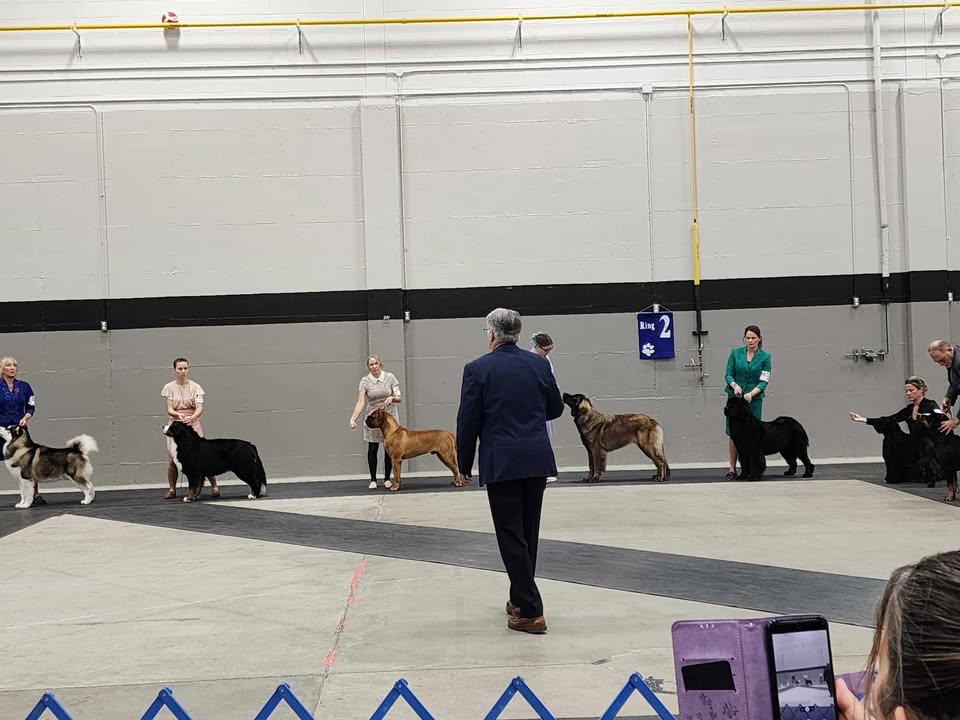
New Exhibitor Resources
Thinking about entering your first dog show? Welcome! Showing dogs in Canada is a rewarding experience, and everyone, handlers, breeders, judges, started exactly where you are now. This page walks you through the basics of getting started with Canadian Kennel Club (CKC) events, step by step.
General Eligibility
Before entering a show, make sure both you and your dog are eligible.
For your dog:
- Must be registered with the Canadian Kennel Club (CKC) or have an appropriate listing number
- Must be of an eligible breed for the event entered
- Must meet age requirements for the class or event
For you:
- You do not need prior experience to enter a dog show
- Junior handling is available for younger exhibitors
- A CKC membership is recommended, but not required to enter.
Dog Show Classes (Conformation)
Dog shows are divided into classes based on age, sex, and other criteria. It’s also important to know that many clubs hold multiple shows over a single weekend or across several consecutive days. Each show is considered a separate event, and your dog is entered independently in each one. Because of this, a dog’s class may change from one show to the next, most commonly due to age.
For example, a puppy may move from Junior Puppy to Senior Puppy, or from the 12-18 month class to open during a multi-day show weekend. Always calculate your dog’s age on the day of each show and confirm the correct class when completing your entries. Many entry services will do this for you, but it’s ultimately the exhibitor’s responsibility to ensure their dog is entered in the appropriate class.
- Junior Puppy: Dogs six (6) months of age and under nine (9) months of age on the day of the show.
- Senior Puppy: Dogs nine (9) months of age and under 12 months of age on the day of the show.
- 12-18 Month: Dogs 12 months of age and under 18 months of age on the day of the show.
- At Specialty shows, the club has the option to split this class as follows:
12-15 Month: Dogs 12 months of age and under 15 months of age on the day of the show.
15-18 Month: Dogs 15 months of age and under 18 months of age on the day of the show.
- At Specialty shows, the club has the option to split this class as follows:
- Canadian Bred: Dogs born in Canada. Champions of any country are excluded.
- Bred By Exhibitor: Dogs owned and handled in the ring by the breeder. The handler must be the owner/co-owner and breeder/co-breeder of the dog. The owner/breeder must handle the dog in this class, but need not handle the dog for further awards.
- Open: All dogs. This class may be divided by colour if permission of the CKC is obtained.
- Specials Only: Dogs that have a recorded CKC registration, Event Registration Number (ERN) or Miscellaneous Certification Number (MCN) and have attained the required points for championship status.
In order for a dog to be recognized as a champion and its owner provided with a championship certificate, the dog must:- earn at least ten (10) championship points under at least three (3) different judges;
- be registered in the records of the CKC, have an Event Registration Number (ERN) or have a Miscellaneous Certification Number (MCN);
- have earned at least one (1) two (2)-point win either at the breed or group level.
Finding Dog Shows in Your Area
One of the best resources for finding events in Canada is Canuckdogs.com. This website is widely used by exhibitors and divides the country into easy-to-navigate regions: Atlantic, Quebec, Ontario, Prairies, and BC & Yukon.
Events are organized by calendar date, making it easy to see what’s coming up in your area. When available, premium lists, judging schedules, and event results are also posted directly on the site.
If you’re new to dog shows, take some time to explore the site and familiarize yourself with how events are listed and organized. Spending a little time navigating Canuckdogs will make it much easier to find shows, track schedules, and plan your entries with confidence.
Practice: Handling Classes and Matches
Practice is one of the best ways to build confidence for both you and your dog before entering a show. The Moncton Kennel Club offers two great opportunities to practice in a supportive environment:
- Training Tuesdays
These handling classes help exhibitors learn and practice essential ring skills such as gaiting, stacking, ring procedure, and presentation. They are ideal for beginners and for dogs that are new to the show environment. - Sanction Matches
Matches are informal, practice shows held under CKC guidelines. They simulate a real dog show without championship points, making them a low-pressure way to gain experience in the ring.
Many other kennel clubs also offer handling classes, matches, or similar practice opportunities. Checking local club websites or event listings can help you find additional ways to practice and learn.
Reading a Premium List
The premium list is one of the most important documents for any dog show, it is essentially the show’s instruction manual. Before entering, take time to read the premium list carefully, even if you have entered shows before.
A premium list provides detailed information about the event, including the dates, location, venue details, judges and their assignments, and the classes offered. It also outlines entry fees, closing dates and times, and exactly how and where entries must be submitted. In addition, the premium list may include event-specific rules, such as parking instructions, grooming restrictions, or requirements unique to that show or venue.
For new exhibitors, the premium list is especially important because it confirms eligibility, helps you choose the correct class for each show, and tells you what to expect when you arrive. It is also where you will find important notes about CKC rules that apply to that particular event.
Premium lists are usually available online through entry services, club websites, or event listing sites. Reading the premium list thoroughly before entering can help prevent costly mistakes and ensure a smoother, more enjoyable show experience.
Making an Entry
Once you have chosen a show and confirmed the correct class for your dog, the next step is making your entry. All entry instructions, including where to send entries, acceptable payment methods, and closing dates, are outlined in the premium list. Be sure to review it carefully before submitting.
Entries can typically be made by mail or through an online entry service. Online services are convenient and widely used, but exhibitors should be aware that there may be additional fees for using an entry service or for paying by credit card. Some exhibitors still prefer to submit entries by mail and pay by personal cheque, which is still commonly accepted when permitted in the premium list.
If you choose to mail your entry, timing is critical. Mailed entries must be received by the show secretary before the published closing date and time. They do not just need to be postmarked by that date. Late or incomplete entries cannot be accepted.
Before submitting your entry, double-check all information for accuracy, including your dog’s registered name and number, class selection, sex, and date of birth. Taking a few extra minutes at this stage can help prevent issues once you arrive at the show.
Reading the Judging Schedule
After entries close, a judging schedule is prepared and sent to each exhibitor, typically by email. It is also commonly posted on the Canuckdogs website. The judging schedule tells you when and where your dog will be judged and is essential for planning your day at the show. Included in the judging schedule sent to each exhibitor is the armband number for each dog. Keep this number with you, you’ll need it on the day of the show!
The schedule lists judging times by ring and breed, along with the judge assigned. Times shown are estimates and can change depending on how efficiently judging proceeds, so exhibitors should always arrive early and be prepared to be ringside well before their scheduled time.
For each breed, the judging schedule usually includes a numerical breakdown of the entries. It may be listed in a format such as:
9 Retriever (Golden) 2–3–1–3
This means there are 9 total Golden Retrievers entered, broken down as:
- 2 class males
- 3 class females
- 1 champion male
- 3 champion females
The judging schedule does not break down individual class divisions such as Junior Puppy, Open, or Canadian Bred. Those details are only found on your entry confirmation, the official catalogue (available for purchase at the show) and in the judge’s book. The schedule is intended to give exhibitors a general overview of the number of dogs entered and the order in which the breed will be judged.
Reviewing the judging schedule in advance will help you understand when your breed will be in the ring and how judging will flow throughout the day.
Day-of-Show Readiness
Show day can feel overwhelming, especially the first time, but a little preparation goes a long way toward making it a positive experience.
Plan to arrive early so you have time to set up, settle your dog, and locate your ring. Check the judging schedule, confirm your ring number, and watch the flow of judging if another breed is ahead of yours. This helps you understand how the judge is working and when your class will likely be called.
Pick up your armband number at the show secretary’s table (if you’re at an AKC show, you’ll typically pick up your armband from the steward in the ring you’ll be exhibiting in). The armband is placed on your left arm, elastics are provided for this purpose, but some exhibitors like to use specialty-made armband holders. The armband allows the judge to mark the judge’s book correctly, and allows spectators who have a catalogue the ability to look up the particulars of any given dog. If your armband is lost or damaged before you’re done showing, ask the show secretary for a new one.
Make sure your dog is groomed and ready well before judging begins. Allow extra time for last-minute touch-ups and bathroom breaks. Keep your armband, bait, and any necessary equipment easily accessible so you are not scrambling when your class is called.
When it is time to enter the ring, listen carefully to the ring steward and follow their instructions. Do not hesitate to ask the steward a question if you are unsure where to go or what to do. Judges expect exhibitors to be respectful and attentive, not perfect.
Most importantly, remember that your first show is about learning. Things may not go exactly as planned, and that is okay. Focus on keeping the experience positive for your dog, observing how others handle their dogs, and enjoying the day. Every show builds confidence, experience, and skills for the next one.
We’re Here to Help
The Moncton Kennel Club is proud to support new exhibitors. Don’t hesitate to ask questions, attend classes, or connect with experienced members. Dog shows are about sportsmanship, community, and celebrating dogs—welcome to the journey!